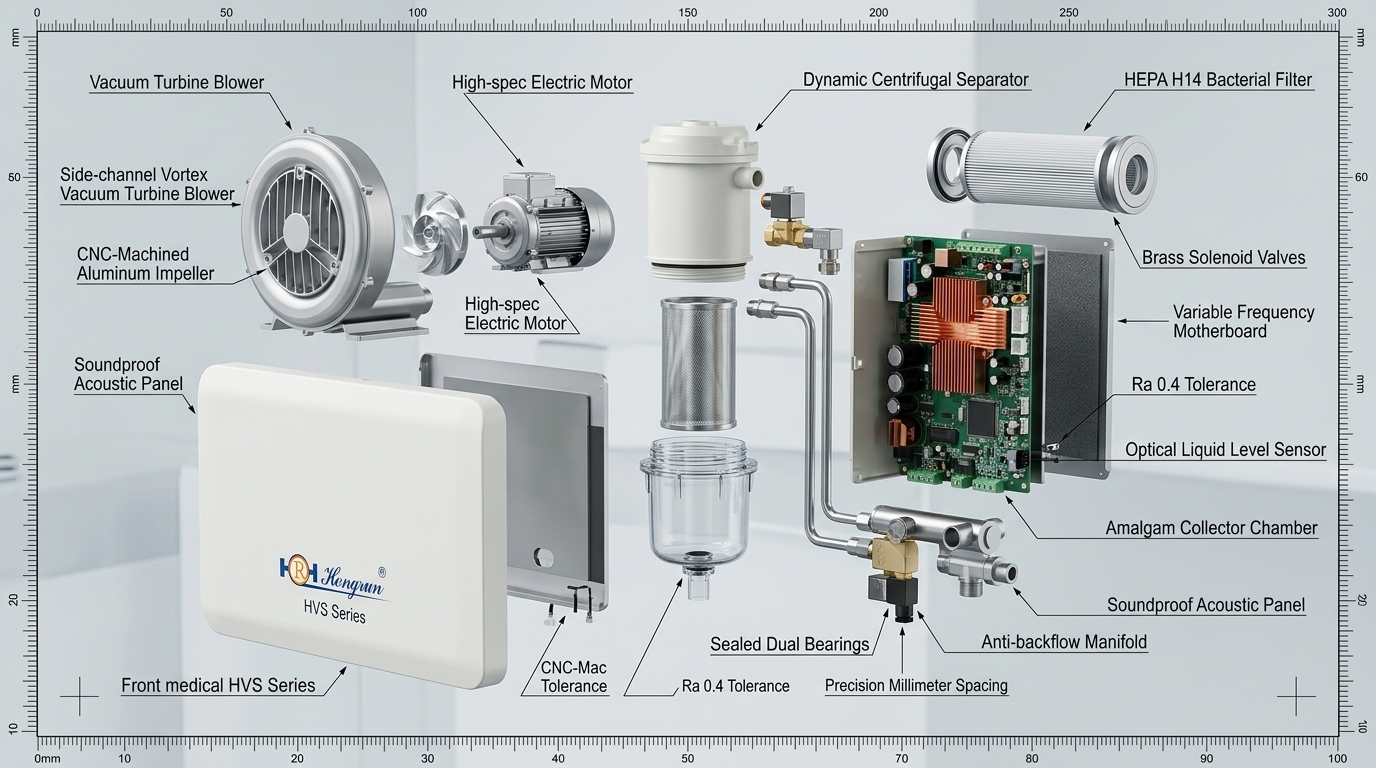
Executive Engineering Summary
In modern stomatology and oral maxillofacial surgery, high-speed dental handpieces generate massive microbial aerosol clouds (>100,000 viable bacteria/m³) that pose severe cross-infection hazards. This engineering whitepaper deconstructs the Hongrun HVS High-Vacuum Suction & Water-Air Separation Platform through 3D CAD exploded blueprints and fluid dynamic sketches. We examine how aerodynamic centrifugal turbine impellers, two-stage dynamic cyclone separation, vortex acoustic damping chambers, and HEPA biological exhaust filtering maintain constant negative suction pressure (−18 to −32 kPa) while achieving over 85% intraoral aerosol containment across 1 to 50 dental chairs.
1. The Clinical Aero-Biological Mandate & Cross-Infection Defense
During ultrasonic scaling, crown preparations, and surgical extractions, coolant sprays mix with patient blood, saliva, and subgingival pathogens, forming highly respirable aerosols (< 5 μm) that remain suspended in operatory air for hours. Standard low-volume saliva ejectors capture less than 30% of these bio-aerosols.
The Hongrun HVS Series is engineered as a high-volume evacuation (HVE) system delivering high suction flow rate (up to 300–600 L/min per chair at ≥ −18 kPa terminal vacuum). Clinical air sampling tests demonstrate that high-flow intraoral suction directly suppresses >85% of aerosol cloud formation at the surgical source, protecting clinicians, dental nurses, and subsequent patients from airborne cross-contamination.
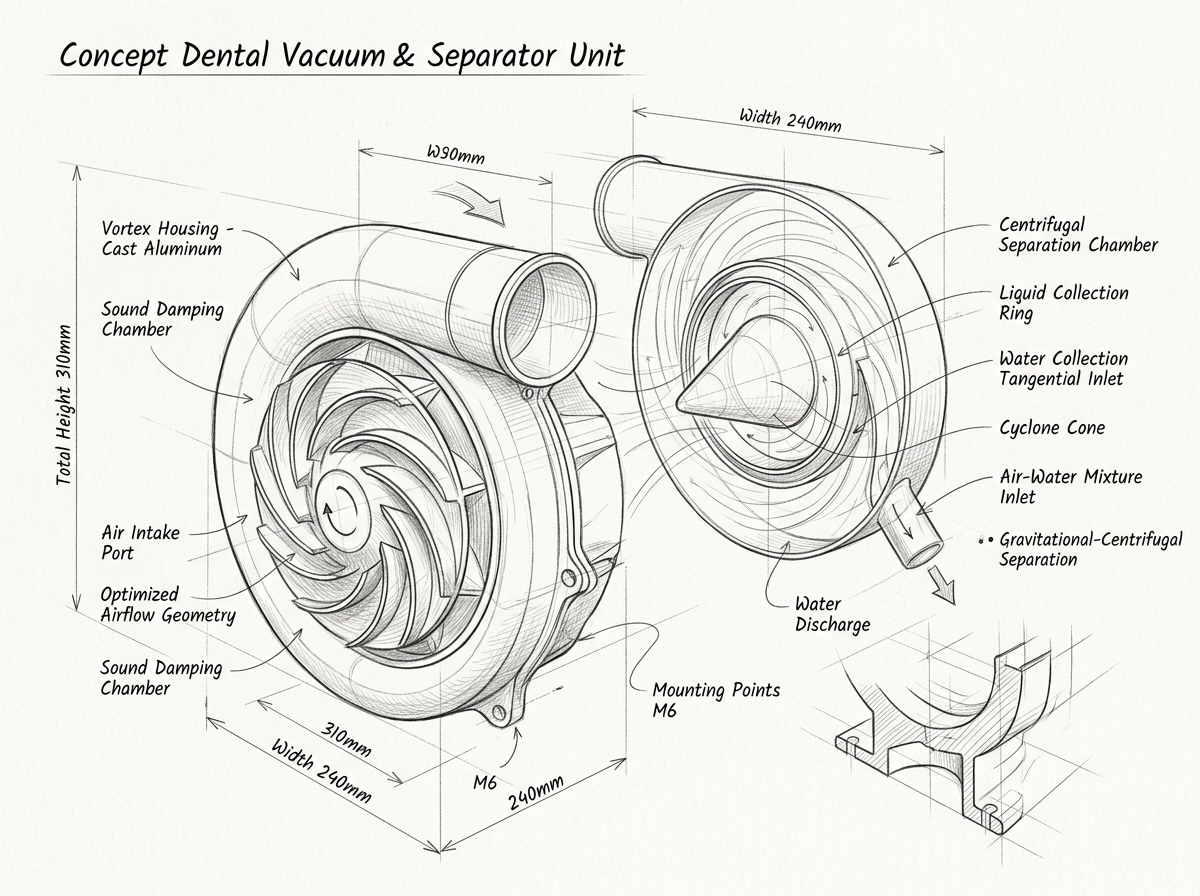
2. Fluidic Design Aesthetics: Handcrafted Turbine & Cyclone Sketches
Fluid separation and aerodynamic noise control require meticulous geometry optimization. Hongrun industrial designers engineered the HVS platform starting with hand-drawn CFD stream path sketches to balance centrifugal separation efficiency against acoustic turbulence:
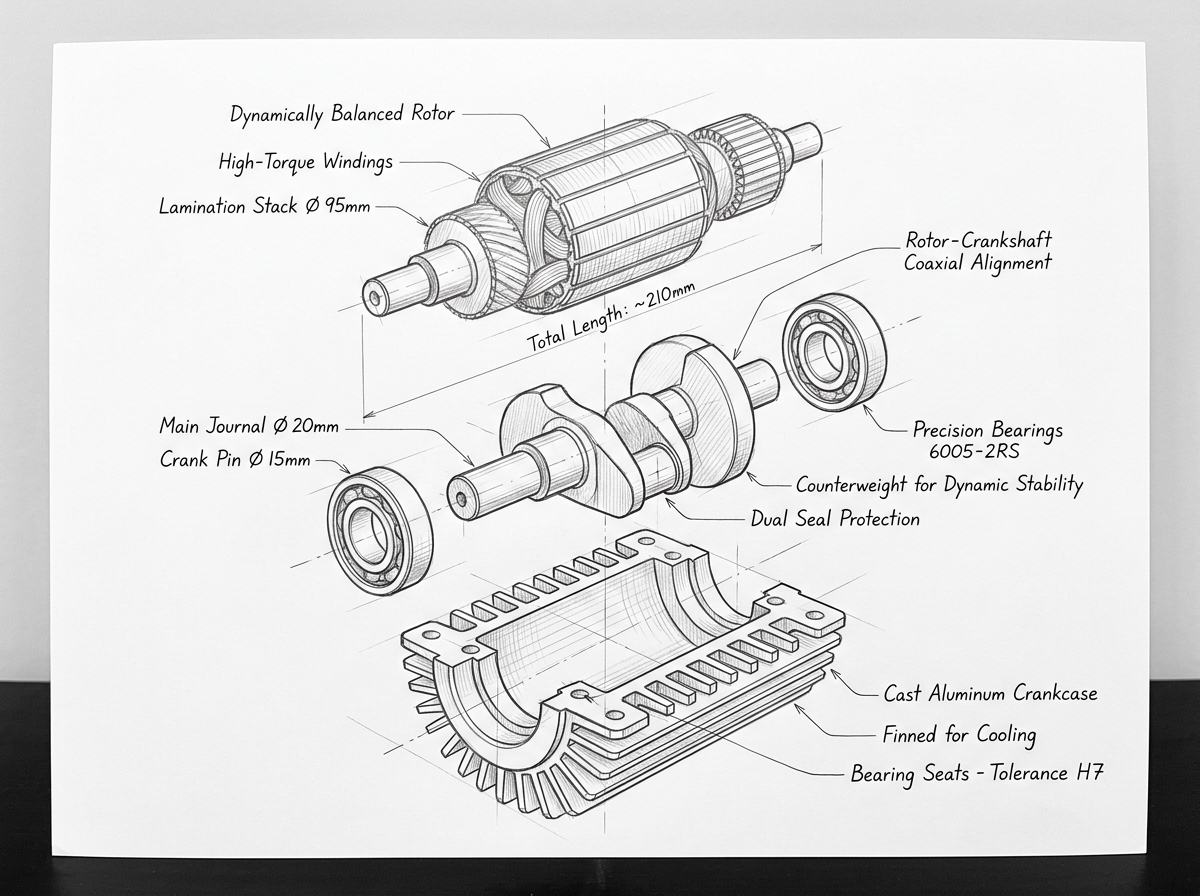
3. Key Mechanical Sub-Assemblies: 3D CAD Engineering Dissection
3.1. Precision Backward-Curved Centrifugal Vacuum Turbine
The core suction generator features a high-grade aluminum alloy aerodynamic backward-curved impeller, dynamically balanced to ISO 1940 Grade G2.5 at 2,850 RPM. The optimized blade curvature creates a powerful vortex low-pressure depression zone, generating stable vacuum (−18 to −32 kPa) while minimizing boundary layer acoustic shearing, ensuring operatory noise stays ≤ 58 dB(A).
3.2. Two-Stage Dynamic Cyclone Water-Air-Solid Separation Chamber
Dental suction fluids contain a chaotic mix of saliva, blood, tooth fragments, and bone chips. Hongrun's patented separation architecture employs a two-stage process:
- Stage 1: Tangential high-velocity cyclonic entry forces heavy liquid droplets and particulates ≥ 0.5 mm against the conical separation wall, precipitating them downward into the automatic drain collector.
- Stage 2: A central multi-vane centrifugal demisting rotor strips micro-aerosols from the air stream, ensuring 100% dry air enters the turbine impeller and completely preventing motor liquid flooding.
3.3. Semi-Wet / Dry System Universal Adaptability
Unlike conventional systems that require separate wet-line or dry-line clinic plumbing, HVS units feature an integrated automatic motorized discharge valve. During continuous surgery, separation and drainage operate simultaneously without losing vacuum pressure or requiring manual chamber dumping.
3.4. Biological HEPA Exhaust Disinfection Unit
The discharge exhaust from the suction unit is passed through an integrated H13-grade HEPA antimicrobial filtration element before venting to the outdoor atmosphere, ensuring zero environmental release of aerosolized pathogens.
4. HVS Technical Sizing & Model Selection Matrix
| HVS Model | Chair Capacity | Max Vacuum Level | Max Flow Rate | Power Rating | Noise Level |
|---|---|---|---|---|---|
| HVS-300 | 1 – 3 Chairs | −18 to −22 kPa | 900 L/min | 0.75 kW / 220V | ≤ 55 dB(A) |
| HVS-500 | 3 – 5 Chairs | −20 to −25 kPa | 1,500 L/min | 1.50 kW / 220V/380V | ≤ 58 dB(A) |
| HVS-700 | 5 – 8 Chairs | −22 to −28 kPa | 2,200 L/min | 2.20 kW / 380V | ≤ 60 dB(A) |
| HVS-1200 | 10 – 15 Chairs | −25 to −32 kPa | 3,600 L/min | 4.00 kW / 380V | ≤ 62 dB(A) |
| HVS-Hospital Dual | 15 – 50 Chairs | −28 to −35 kPa | Up to 7,500 L/min | Dual 4.0kW VFD Skid | ≤ 65 dB(A) |
5. Clinic Vacuum Piping & Pneumatic Balancing Rules
To prevent vacuum decay across long clinic pipeline runs, Hongrun application engineers recommend:
- Main Trunk Line Sizing: Use sanitary PVC-U or ABS piping with ID ≥ 50mm for up to 5 chairs, and ID ≥ 75mm for 10–15 chairs, maintaining a 1% downward slope toward the central plant room.
- Dual-Redundancy Hospital Skid: For clinics >10 chairs, pair two HVS units in parallel with automatic PLC lead-lag switching to guarantee 100% surgical availability. Explore HVS Series →
- Combined Air + Vacuum Plant Room: Pair with HYT series oil-free compressors for complete zero-oil air and high-flow suction integration. View Clinic Solutions →
Hongrun R&D Vacuum & Fluid Engineering Team
Suction & Separation SpecialistSpecializing in clinic negative pressure piping simulations, dynamic cyclone water-air separation chambers, and centralized hospital suction tenders.
Related Technical Insights & Engineering Whitepapers
Inside Zero-Oil Purity: 3D Exploded Anatomy of Air Compressors
5-axis CNC drive shafts, diamond-coated PTFE rings, and dual-tower PSA desiccant dryers.
Sizing GuideSelection Reference for 15 Dental Chairs Operatory
Pneumatic piping design, simultaneous usage factor calculations, and vacuum suction pairing.